Tartine Bakery Mill Valley Brings a Bay Area Sourdough Tradition to Marin
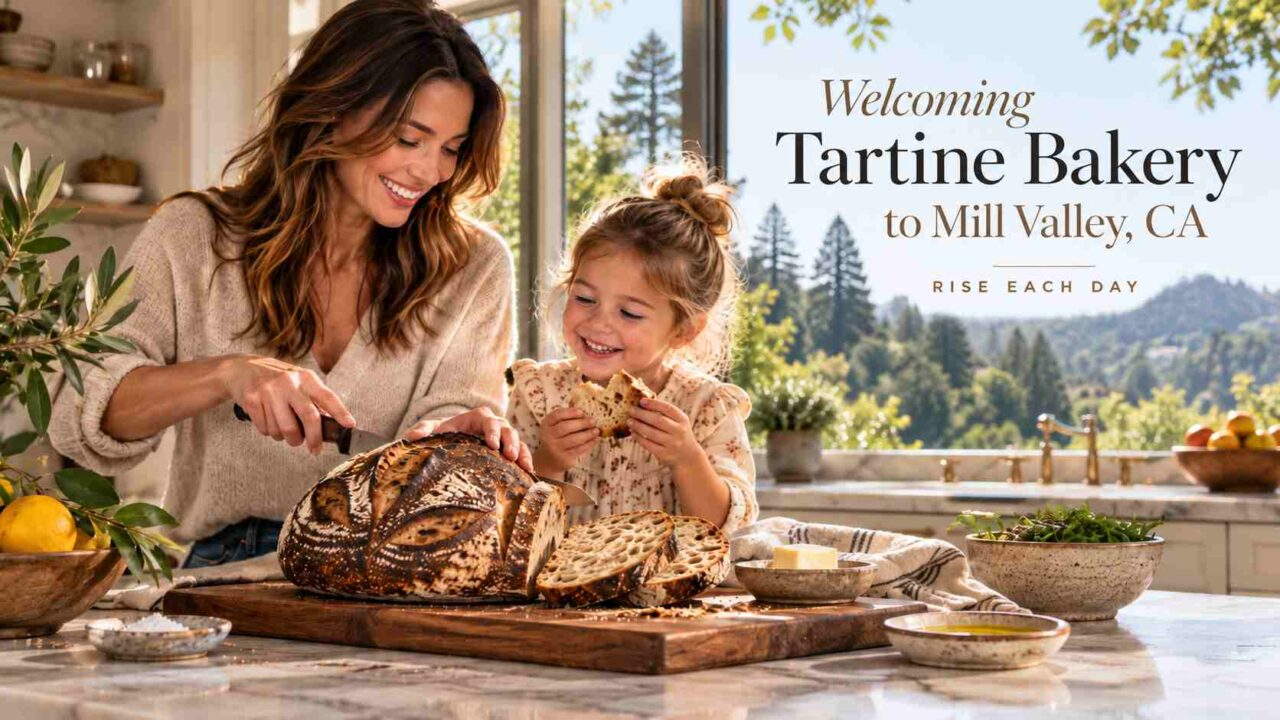
This August, Tartine opened its first Marin County location at Strawberry Village, bringing with it the sourdough bread, pastries, morning buns and coffee that have helped make the bakery such a recognizable part of Bay Area food culture.
I am Dr. Frances H. Yankie, a dentist in Mill Valley, CA, and while I could certainly turn this into a discussion about carbohydrates, sugar and coffee stains, that would miss the more interesting story.
What fascinates me about Tartine is not simply that the bread is good. It is what good bread tends to represent: patience, craftsmanship, memory, family, and the kind of time together that does not need to be scheduled on a shared calendar.
Bread has always been one of those foods that quietly sits at the center of family life. It gets torn apart before dinner is served, passed around the table, buttered while people are talking, and somehow disappears faster than anyone remembers eating it. It does not usually announce itself as meaningful, yet some of our strongest food memories are built around exactly that kind of ordinary moment.
My Thoughts On Sourdough
Sourdough has an especially deep connection to San Francisco and Northern California, where the tradition became closely associated with the Gold Rush era and the bakers and miners who maintained living starters from one batch to the next.
That history matters because sourdough is not simply another type of bread. Its character comes from fermentation and from a living starter made up of yeasts and bacteria that must be fed, watched and maintained over time.
The Bay Area did not invent fermentation, of course, and sourdough exists all over the world, but San Francisco turned it into part of its identity. The flavor, the crust, the chew, the tang, the irregular holes inside a well-made loaf—people here notice these things.
We notice them perhaps more seriously than bread deserves, but that is part of the charm.
And Tartine became one of the modern bakeries that helped push that Bay Area sourdough tradition into a new generation.
What Makes a Sourdough Starter So Different From Ordinary Bread?
A sourdough starter is a remarkably simple thing on paper: flour and water combined in a way that allows a community of naturally occurring yeast and bacteria to develop and sustain itself.
Altough scientifically correct, those of us native to the Bay Area know that Sourdough Starter is generational. Keeping it alive is a task of romance, and family… A starter needs attention. It needs to be fed. It reacts to temperature, timing, flour, hydration and the rhythm of the kitchen in which it lives. After enough time, the person maintaining it stops relying entirely on measurements and begins recognizing what it should look like, smell like and feel like.
That knowledge is difficult to reduce to instructions. You can explain the science, but it’s hard to explain the Starter pride to those outside of the Bay Area, and why people become so attached to their Starter.
Why Good Yeast and a Strong Sourdough Starter Still Require Human Judgment
This is one of the places where I think our fascination with technology becomes interesting.
Artificial intelligence can explain fermentation. It can describe the role of wild yeast and lactic acid bacteria. It can calculate percentages, hydration, temperature ranges and fermentation times faster than most of us would ever want to do by hand.
What it cannot do is understand the relationship a baker develops with a starter.
It cannot stand in a kitchen, lift the lid from a jar and know from experience that the starter is behaving differently today.
It cannot smell the dough and remember another kitchen from thirty years ago.
It cannot inherit a starter from a parent, keep it alive through a move, divide it with a child, and understand why that little jar of flour and water has suddenly become part of a family story.
That difference matters… Technology can explain the process, but experience gives the process meaning.
Baking Bread Together Creates a Kind of Family Time We Rarely Schedule
One of the most appealing things about bread is that it refuses to be hurried.
You can send a message instantly, order dinner in seconds and have almost anything delivered to the house without speaking to another person, but yeast still has its own ideas about time.
Dough needs to ferment. A starter needs to develop. Bread rises when it is ready, not when your schedule says it should be. That slower pace creates something valuable inside a home.
Someone starts the dough in the morning. Someone else checks on it later. The bowl moves around the kitchen. Flour ends up where nobody intended it to go. By evening, the smell of bread begins traveling through the house long before dinner reaches the table.
Nothing about that is dramatic, yet it creates a shared experience.
Why Baking Sourdough Bread Can Become a Family Tradition
Families do not always bond through grand experiences. Quite often it happens through repetition.
The same recipe at holidays. The same soup when someone is sick. The same cake for birthdays. The same loaf of bread made often enough that everyone begins recognizing the smell before they see it.
A sourdough starter fits beautifully into that kind of tradition because it can actually continue from one generation to another.
Part of a starter can be given away without destroying the original. A daughter can take some. A son can take some. A friend can begin a new loaf in another kitchen, and suddenly the same living culture is producing bread in several homes.
There is something lovely about that. The bread is not identical in every kitchen because the flour changes, the water changes, the temperature changes and the baker changes. The connection remains.
Tartine Bakery Mill Valley Fits the Way This Community Thinks About Food
Mill Valley is a place where people tend to care about ingredients, quality and how things are made.
We shop at farmers markets. We ask where food came from. We notice when somebody has taken the time to do something properly. We are also perfectly capable of discussing a loaf of bread for longer than some people discuss politics.
That makes Tartine feel less like an imported San Francisco brand and more like something that fits naturally into the community.
There is also a broader cultural connection.
People here value wellness, but they also value pleasure. We hike, exercise, talk about nutrition and then sit down with coffee and something good from a bakery.
I see nothing contradictory about that. Do you?
Good Bread Does Not Need a Health Warning Attached to It
As a dentist, I am fully aware that bread contains carbohydrates, pastries contain sugar and coffee can stain teeth. But that does not mean every bakery visit needs to become a dental lecture.
As a mother, I always took Motherly-Pride when I baked banana bread for my boys. It tought them not to waste things (the over-ripe banana) and to be patient (while it cooks) and savor the scent and the smell and the crunch of the pecans (or walnuts).
Whether you go to Tartine Bakery in Mill Valley alone, in a group, as a family, or a with that new special person you’ve recently met, enjoy it as it is meant to be… a time to slow down, appreciate the craft, sit down for pastry, drink the coffee and cherish the moment and the tradition. And don’t forget to take a croissant for the road, or the bread of your choice. Take it home, slice it, and make a memory of the moment from it.
OK, and afterwards don’t forget to do what you should already be doing: brush thoroughly, floss, drink water, keep up with your professional cleanings and avoid spending the entire day grazing or sipping sweetened drinks.
I had to get that in there. It’s my job! I would much rather see people develop sensible habits than become afraid of individual foods.
Coffee, Sourdough and Teeth: A Little Common Sense Goes a Long Way
Since I am still a dentist, there is one practical point worth making.
Coffee can stain teeth over time. So can tea, red wine, berries and many other things people enjoy regularly. That kind of discoloration does not automatically mean the teeth are unhealthy; often it simply reflects years of normal eating and drinking.
If someone wants a brighter smile, that is a perfectly reasonable cosmetic concern.
At my Mill Valley dental office, I offer The Smile Perfected™ brand of teeth whitening for patients who want to brighten their teeth professionally. I prefer whitening to be part of regular dental care because I want to know first that the teeth and gums are healthy and that ordinary staining is actually what we are treating.
And no, I am not going to tell you to stop drinking coffee. That would be especially unrealistic now that Tartine is in town. After that, if you want your smile brighter, I can help you with my Pain-free Smile Perfected™ Whitening System.
Welcome to Tartine Bakery Mill Valley
What I hope happens with Tartine is simple… I hope people go for the bread and stay longer than they expected. I hope families bring loaves home for dinner. I hope someone tastes the sourdough, becomes curious about making it, and ends up with a jar of starter living on the kitchen counter for the next fifteen years.
I hope children grow up recognizing the smell of bread baking at home and associate it with being together around a table rather than with something that arrived in a cardboard box at the front door.
Good food has always been able to do that.
It feeds us, certainly, but it also gives us rituals, memories and reasons to stop what we are doing for a while and sit down together.
A sourdough starter is especially good at reminding us of that because it cannot be rushed, automated or entirely reduced to instructions.
You can explain the microbiology. You can measure the flour. You can calculate the hydration.
But the part that turns a starter into something a family keeps, shares and remembers still belongs to the people in the kitchen.
From one Mill Valley business to another, welcome to town, Tartine.
I hope you are here for a very long time.
From one Mill Valley resident to another, I hope you are here for a very long time, too.