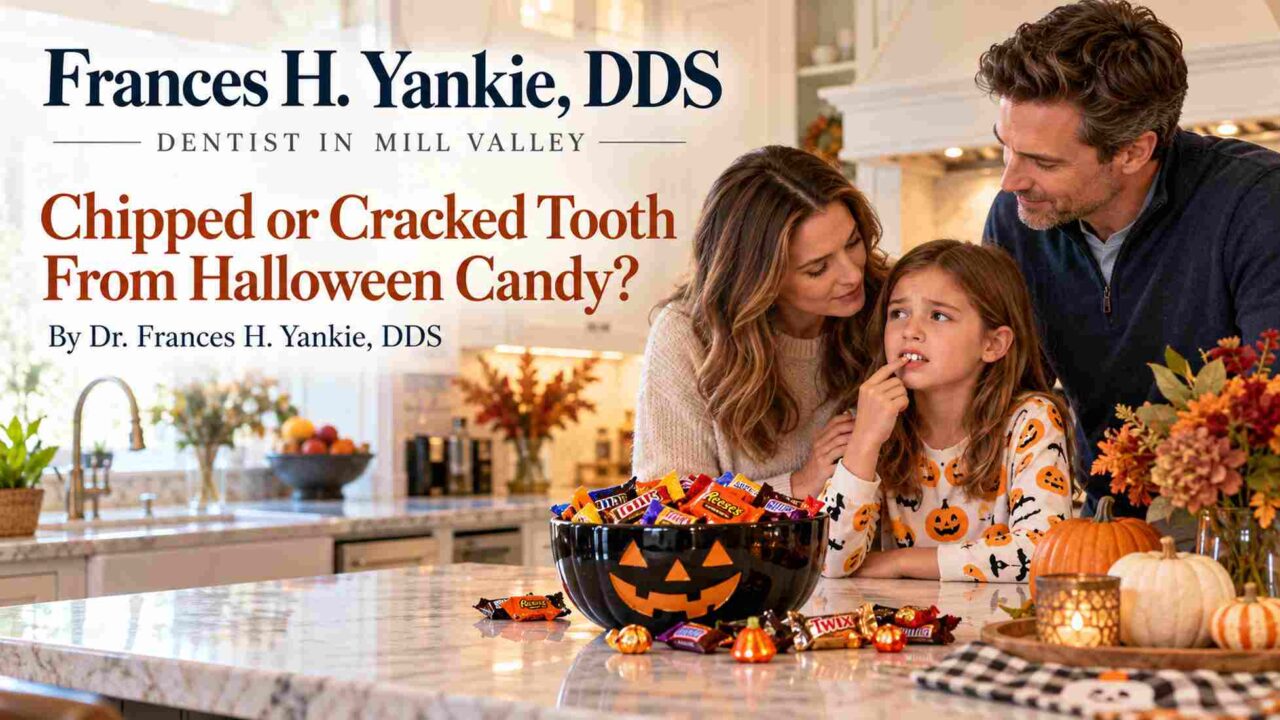
Halloween Candy can cause more than Cavities. Every October, dentists are expected to say something about Halloween candy and cavities. I understand why. Children come home with enough sugar to stock a small convenience store, parents pretend they are only checking the candy for safety while quietly removing their favorites, and somewhere a dentist is reminding everyone to brush.
I am Dr. Frances H. Yankie, a dentist in Mill Valley, CA, and as a mom of two, I have spent enough Halloweens around children and candy to know that the sugar is only part of the story. That’s why I want to talk about something that can happen much faster than a cavity.
You bite down on a piece of hard candy, a caramel-covered nut, a frozen chocolate bar, or something that seemed perfectly harmless until your tooth suddenly feels different. Maybe you hear a small crack, maybe a piece of tooth or filling comes away, or perhaps there is no immediate pain at all and you only realize something happened because your tongue keeps finding a new sharp edge that was definitely not there five minutes ago.
Here in Mill Valley, Halloween tends to be taken seriously enough that the city has its Old Mill Halloween Parade, activities at the Community Center and neighborhoods such as Sycamore Village that attract large numbers of trick-or-treaters. With that much candy changing hands, I think it is worth talking about the dental problem that has less to do with how much sugar you eat and more to do with what happens when a tooth meets something harder or stickier than expected.
Chipped Tooth or Cracked Tooth? They Are Not Always the Same Thing
Patients often use “chipped,” “cracked” and “broken” interchangeably, which is understandable because from the patient’s perspective the important part is usually that something happened to a tooth and it no longer feels right. From a dental perspective, though, the distinction matters because the depth and location of the damage often determine what treatment is needed.
A small chip may involve only the outer enamel and cause little or no discomfort. A larger piece of the chewing surface can break away, particularly around an older filling, while a true crack can extend deeper into the tooth and may involve dentin, the pulp or, in more serious cases, portions of the tooth below the gumline.
That is why I do not like diagnosing a cracked tooth based solely on how much it hurts. Some cracked teeth produce sharp pain when you bite, particularly when you release pressure, while others become sensitive to hot or cold foods and drinks. The frustrating ones may hurt intermittently, disappear for a while and then return just when you have convinced yourself that whatever happened has somehow resolved on its own.
The amount of discomfort does not reliably tell us how far a crack extends, which is why an examination matters even when the pain seems minor.
Why Hard Candy Can Chip or Crack a Tooth
Hard candy earns its name honestly, but the problem is not that every piece is waiting to fracture a healthy tooth. Most people can eat Halloween candy without incident. The risk increases when the candy is very hard, when someone bites into it instead of allowing it to dissolve, or when the tooth already has a structural weakness that the person may not know exists.
Teeth with large fillings, older restorations, existing cracks or areas weakened by decay may tolerate normal chewing perfectly well until one poorly placed bite concentrates enough force in the wrong spot. In those situations, either the candy gives way or the tooth does, and unfortunately the tooth does not always win.
Sticky candies create a slightly different problem. Caramels, taffy and similar candies can pull at crowns, fillings and other restorations, particularly if something was already loose or compromised. This does not mean one piece of caramel will dismantle your dental work, but Halloween has a way of introducing teeth to foods they may not encounter quite so enthusiastically during the rest of the year.
What Does a Chipped Tooth Feel Like?
A chipped tooth can announce itself in several ways. You may notice a rough or sharp edge with your tongue, see that part of the tooth looks different in the mirror, or realize that a small piece has come away while you were chewing. Some chips cause no pain because they remain within the enamel, while others expose deeper layers of the tooth and create sensitivity, particularly to cold air, drinks or sweets.
The location of the chip also matters. A small chip on a front tooth may be more cosmetic than painful, although that does not make it unimportant. A fracture involving a back tooth can affect the chewing surface and place additional stress on what remains.
Fortunately, many chipped teeth can be repaired. Depending on the size and location of the damage, treatment might involve smoothing a very minor rough edge, bonding the missing area with tooth-colored material, restoring the tooth with a filling, or placing a crown when more of the tooth has been lost.
What you cannot reliably do is determine the extent of the damage by running your tongue over it and deciding that it “doesn’t seem too bad.” A tooth can feel surprisingly normal even when it deserves a closer look.
What Does a Cracked Tooth Feel Like?
Cracks can be more deceptive because the symptoms are not always constant. One of the classic signs is pain when chewing or when releasing the bite, although not every cracked tooth behaves that way. Some people notice sensitivity to hot or cold temperatures, while others experience discomfort that appears and disappears without an obvious pattern.
That intermittent nature is precisely why people sometimes wait. The tooth feels bad on Saturday, better on Sunday and almost normal by Monday, so it is tempting to conclude that the problem has passed. Unfortunately, a crack in a tooth does not heal the way a fracture in a bone can heal, and continued chewing forces can sometimes allow the crack to progress.
The earlier we evaluate it, the better chance we have of understanding what is happening before repeated stress makes the situation more complicated.
What Should You Do If You Chip or Crack a Tooth?
If you bite into Halloween candy and suddenly realize you have chipped or cracked a tooth, there is no need to panic, but there are a few sensible things to do.
Rinse your mouth gently with warm water so the area is clean. If there is swelling from an injury, a cold compress on the outside of the face can help. If a piece of tooth has broken off, save it if you can and bring it with you to the dental office.
Then call your dentist and, until you are seen, avoid chewing on that side of your mouth, particularly if the tooth feels unstable or painful. Extremely hot or cold foods may also be uncomfortable if deeper layers of the tooth have become exposed.
I would also avoid repeatedly testing the tooth. People do this without realizing it. They bite down again to see whether it still hurts, then try once more because perhaps they imagined it. If something feels cracked, loose or structurally different, repeatedly loading it with chewing pressure is not going to provide useful information and may only make the area more uncomfortable.
When a Cracked Tooth Needs Prompt Dental Attention in Mill Valley
Pain is certainly a reason to call, but it is not the only one. A visible fracture, a loose portion of the tooth, swelling, bleeding, sensitivity that lingers, or a tooth that suddenly feels different when you bite all deserve attention. A significant facial injury, uncontrolled bleeding or suspected jaw fracture requires more urgent care.
The American Association of Endodontists emphasizes that early evaluation matters because the treatment and prognosis depend heavily on where the crack is located and how far it extends.
That does not mean every cracked tooth leads to a root canal or a crown, and it certainly does not mean every chipped tooth is an emergency. It simply means that teeth are difficult to assess from symptoms alone, and a small chip and a deeper crack may feel surprisingly similar at first.
Broken Fillings and Crowns Can Join the Halloween Fun Too
Natural teeth are not the only things that can object to hard or sticky candy. Fillings and crowns live in the same environment and experience the same chewing forces, and older restorations may eventually weaken enough that a sticky or very hard food exposes a problem that was already developing.
A filling may fracture along with part of the tooth around it, while a crown can loosen or come off. Occasionally a person thinks the tooth itself has broken when what they are actually feeling is a damaged restoration.
From the patient’s point of view, that distinction is not especially important in the moment because something has changed and needs to be examined. If a crown comes off, keep it and bring it with you. Do not attempt to permanently glue it back into place with household adhesive. There are temporary dental products intended for short-term use, but whether a crown can simply be recemented depends on why it came off and what condition the underlying tooth is in.
A five-minute home repair can sometimes create a much longer dental appointment, so this is one of those situations where it is better to let the dentist determine what needs to happen next.
Your Dentist in Mill Valley Is Not Going to Confiscate the Halloween Candy
I get it… Halloween is supposed to be fun, and I am not going to pretend candy is somehow off-limits for one night. The better approach is simply to be sensible about what you are biting into, especially if you have older fillings, crowns, or a tooth that has already been giving you trouble.
Hard candy is better allowed to dissolve than challenged with your molars, and very sticky candy deserves a little caution if you have extensive dental work. Afterward, brush and floss as usual and move on with your evening. What matters far more to me is the pattern that follows Halloween—when the candy bowl stays on the counter for the next few weeks and turns into an all-day habit rather than a one-night treat.
The sensible approach is moderation and a little common sense. Hard candy is better allowed to dissolve than attacked enthusiastically with your molars, and very sticky candy deserves a little caution if you have extensive dental work, older crowns or fillings. If you already know you have a cracked tooth or a restoration that has been giving you trouble, Halloween night is probably not the ideal time to test its structural limits.
Once the evening is over, brush thoroughly with fluoride toothpaste, clean between the teeth and return to your normal routine. One night of Halloween candy is not what concerns me most; the bowl that sits on the kitchen counter for the next three weeks and gets visited all day long is usually far more relevant from a dental standpoint.
If the Candy Wins, It’s Time To See Me; A Dentist Mill Valley
The strange thing about chipped and cracked teeth is how ordinary the moment can be. You are simply eating something, you bite down, and suddenly the tooth you had not thought about all day becomes the only thing you can think about.
If that happens this Halloween, do not assume that the absence of severe pain means everything is fine. A small chip may be simple to repair, while a deeper crack deserves attention before repeated chewing forces make the situation more complicated. I would much rather evaluate something early, while we still have a clear picture of what happened and what options make sense.
So enjoy Halloween. Walk through Mill Valley, admire the costumes, let the children collect far more candy than any reasonable household needs and quietly claim whichever pieces constitute your parental service fee. Just use a little common sense with the hardest and stickiest candy.
And if you hear a crack that definitely did not come from the candy, call my office for an urgent appointment by using our online Easy Appointment Tool. You can also text or call for an appointment at (415) 383-0824